
Zomato: How Humor Became a Competitive Advantage !
1. The Hook
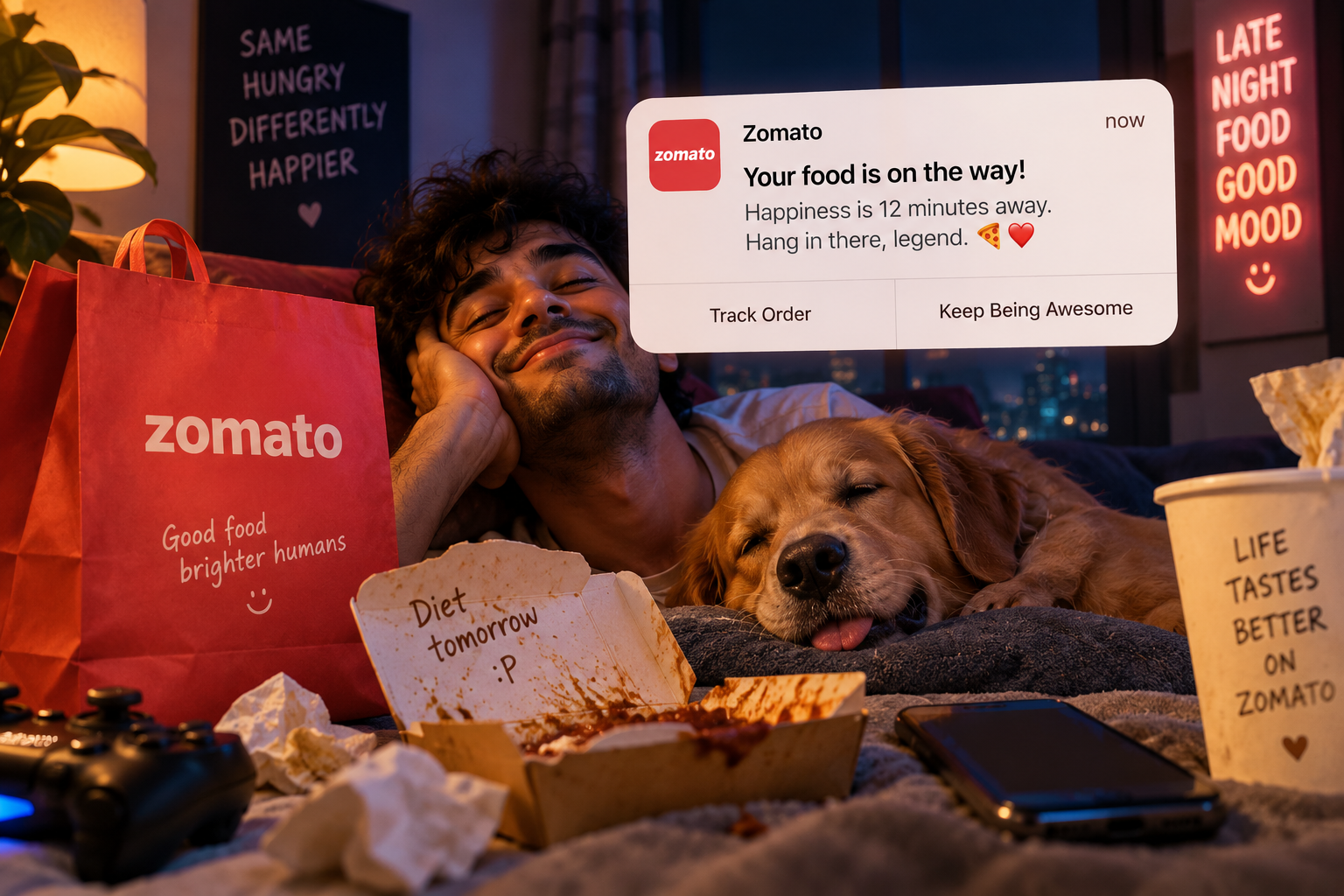
Most food-delivery apps compete on speed and discounts. Zomato competes on whether you laughed at its last notification.
That is the strange, uncomfortable truth sitting underneath India’s food-delivery category: the product is close to a commodity, the discounts are matchable within a week, and the delivery times differ by minutes, not experience. Yet Zomato has spent the better part of a decade building something none of its rivals can order off a menu — a personality people recognise on sight, quote to their friends, and occasionally argue with on Twitter. This case study is about how that happened, and why it is one of the hardest competitive moats to replicate in modern marketing.
2. The Business & Marketing Context
Zomato is an Indian food-delivery and restaurant-discovery platform, now operating under the listed entity Eternal, that connects consumers with restaurants for delivery, dining-out discovery, and — through its group companies — quick commerce and event ticketing. Its core delivery business competes directly with Swiggy in a two-player market where both platforms offer overlapping restaurant catalogues, comparable delivery windows, and near-identical fee structures.
This is what makes food delivery a structurally hard category to market. When two apps carry the same restaurants, charge similar delivery fees, and promise similar delivery times, the product itself stops being a reliable differentiator. Coupons and discounts can be matched within days. Delivery-time improvements are usually matched within a quarter. What is much harder to copy is a recognisable communication style that a customer can identify without seeing the logo — and that is the gap Zomato chose to fill.
The marketing challenge, stated plainly, was this: in a category where the functional pitch is identical across competitors, how do you give people a reason to feel something about your brand rather than simply transact with it?
3. The Strategic Insight
Zomato’s answer was to stop advertising like a food-delivery company and start behaving like a media publisher with an opinion. The insight was simple to state and hard to execute: in a commoditised category, personality is the product feature competitors cannot copy overnight.
Humor became central to that personality for three linked reasons. First, humor is disarming — a joke lowers a consumer’s guard in a way a discount banner never does, because it doesn’t ask for anything in return. Second, cultural relevance signals that a brand is paying attention to the same conversations its audience is having, which builds a sense of being understood rather than sold to. Third, a recognisable personality creates what marketers call distinctive brand assets — a tone, a rhythm, a way of phrasing things — that people can identify even with the logo removed, which is a far stronger form of brand recall than a tagline repeated in media spend.
This is also how Zomato moved beyond conventional food-delivery advertising. Instead of running campaigns that exist for a fixed flight of weeks and then disappear, Zomato built a communication system — social posts, app notifications, push copy, billboards, and topical creative — that behaves less like advertising and more like an always-on voice reacting to the culture in real time.
4. The Zomato Brand Voice
Strip away the visuals and Zomato’s copy is still identifiable. That is the test of a genuine brand voice, and Zomato’s holds up against it. A few characteristics define it:
Conversational language
Zomato writes the way a friend would text, not the way a company would advertise. Notification copy such as “Hey, food is your soulmate. Don’t ghost it” reads like a message from a person, which is precisely the point — people trust people more than they trust brands.
Wit and self-awareness
Zomato is comfortable making fun of its own category — hunger, cravings, indecision, and even its own service hiccups. A brand willing to laugh at itself signals confidence, and confidence reads as trustworthiness.
Pop-culture and Indian cultural fluency
References to Bollywood dialogue, cricket, festivals, and everyday Indian phrases (mixing Hindi and English the way urban India actually speaks) make the content feel local rather than translated.
Relatability over aspiration
Where much advertising sells an aspirational lifestyle, Zomato sells the mundane truth of ordering food because you’re tired, heartbroken, or simply don’t want to cook — and says so plainly.
Short-form copy and timing
Zomato’s strongest content is rarely more than a line or two. The brevity is deliberate: a joke that requires explanation has already failed, and short copy travels faster on social feeds.
Visual simplicity
Much of Zomato’s viral social content — including its 2026 IPL creative for RCB’s title win, a simple grid of crosses followed by two trophy emojis and the line “Trust the Process” — relies on a single strong visual idea rather than layered design, which makes it easy to screenshot and forward.
Each of these traits works because it lowers the psychological distance between brand and consumer. A company that sounds like an institution gets tuned out; a company that sounds like a peer gets engaged with.
5. Real-Time Marketing
This is where Zomato’s strategy is most visible — and most instructive. Real-time marketing only works when a brand can recognise a cultural moment and respond within hours, not days. Five examples illustrate the pattern.
Example 1 — RCB’s IPL 2026 title defence
Context: In June 2026, Royal Challengers Bengaluru defended their IPL title against Gujarat Titans, a franchise long associated with an 18-year trophy drought before finally winning in 2025.
Zomato’s response: A minimal graphic — a grid of red crosses representing years of heartbreak, followed by two trophy emojis and the caption “Trust the Process.”
Why it worked: The creative required no explanation for anyone who follows Indian cricket, compressed years of fan pain into one visual, and used restraint rather than a wall of text — a rarer move in a feed full of brands rushing to react.
Marketing lesson: Real-time marketing doesn’t need to be elaborate. The fastest, simplest read of a cultural moment usually outperforms an over-produced one.
Example 2 — #ZomatoSixes during IPL 2025
Context: IPL 2025 opened with a Kolkata Knight Riders–Royal Challengers Bengaluru match watched by a huge live audience, the traditional peak moment for Indian advertisers.
Zomato’s response: A campaign tying food offers and content to sixes hit during live matches, encouraging fans to share their own “#ZomatoSixes” moments and turning the promotion into user-generated content rather than one-way advertising.
Why it worked: Launching on the opening day let Zomato claim the cultural moment before competitors cluttered the conversation, and tying a promotional mechanic to something fans were already emotionally invested in — a six being hit — made the brand feel part of the match rather than an interruption to it.
Marketing lesson: The best real-time campaigns don’t just comment on a moment — they give the audience a way to participate in it.
Example 3 — Zomato Premier League (ZPL) during IPL season
Context: Cricket dominates Indian attention for roughly two months a year, and “second-screen” behaviour — ordering food while watching a match — is extremely common.
Zomato’s response: A gamified layer over the IPL itself: users predict match outcomes and unlock food deals, supported by TV spots (including one featuring former cricketer Virender Sehwag) and social promotion.
Why it worked: Rather than simply advertising during cricket, Zomato built a companion experience for cricket, which meant the brand earned attention through utility and entertainment rather than paid interruption alone.
Marketing lesson: Owning a recurring cultural calendar moment (a season, not just a single event) compounds brand association year after year.
Example 4 — Everyday viral banter: the “Akansha” exchange
Context: A screenshot of a witty text exchange, purportedly between Zomato’s social team and a customer named Akansha, spread widely online and generated its own wave of memes and commentary.
Zomato’s response: The brand’s official account leaned into the exchange publicly rather than staying silent, amplifying the organic buzz instead of controlling it.
Why it worked: It blurred the line between brand content and user content — audiences couldn’t always tell where Zomato’s marketing ended and genuine internet culture began, which made the moment feel authentic rather than manufactured.
Marketing lesson: When a brand’s tone is consistent enough, its audience starts producing brand content for it — the strongest possible signal that a voice has actually landed.
Example 5 — Festival and movie-moment one-liners
Context: Major festivals and Bollywood releases generate predictable spikes in social conversation across India.
Zomato’s response: Short, contextual one-liners timed to festivals and film releases — often built around a single pun or reference rather than a full campaign.
Why it worked: The content asks almost nothing of the reader — a few seconds to read, an instant “I get it” — which is exactly what a scrolling feed rewards.
Marketing lesson: Not every moment needs a campaign budget. A large share of Zomato’s most-shared content is simply a well-timed sentence.
6. Social-Media-Native Advertising
The clearest way to understand Zomato’s approach is to compare it against traditional advertising logic.
Traditional advertising
- The brand speaks; the consumer watches.
- The consumer is a passive recipient of a fixed message.
- A campaign has a defined flight — it launches, runs, and ends.
Social-native advertising
- The brand participates in a conversation that is already happening.
- Content is built to be shared, screenshotted, and re-posted, not just viewed.
- Timing is part of the creative itself — a joke about a cricket match only works during or immediately after that match.
- The audience becomes part of the distribution system, replying, quoting, and remixing the content.
This distinction matters because it changes what “good creative” even means. A traditional ad is judged on production value and message clarity. A social-native post is judged on how quickly someone hits share — which rewards timing and cultural fluency over polish.
7. The Psychology Behind the Humor
Several consumer-psychology mechanisms explain why this approach works so consistently, beyond “people like to laugh.”
Familiarity and mere exposure
Repeated, low-effort brand touchpoints — a witty notification here, a meme there — build familiarity over time, and familiarity reliably increases liking, even when each individual touchpoint is small.
Relatability and social identity
When Zomato jokes about ordering food out of heartbreak or laziness, it isn’t describing a product benefit — it’s describing the reader. People share content that reflects their own identity back at them, because doing so signals something about who they are to their own social circle.
Pattern recognition and distinctive assets
Once an audience has seen enough Zomato content, they can recognise the brand’s tone even without a logo, the same way people recognise a friend’s texting style. This is a distinctive brand asset in the classic marketing sense — something a competitor cannot copy just by using similar words, because the recognition is built on repetition and consistency over years.
Surprise and emotional association
A well-timed joke creates a small positive emotional spike, and that spike gets associated with the brand rather than the moment alone — which is why people remember Zomato’s reaction to a cricket final long after they’ve forgotten the score.
Shareability and cultural belonging
Sharing a Zomato post is a low-cost way for someone to signal humor and cultural awareness to their own network. The brand becomes a vehicle for the sharer’s own social currency, not just a company being promoted.
8. Humor as a Competitive Advantage
Humor, applied consistently over years, compounds into several measurable business advantages: greater mental availability (being the brand that comes to mind first in a buying moment), stronger unaided recall, higher organic engagement that reduces dependence on paid media, and a level of cultural relevance that keeps the brand part of everyday conversation rather than only appearing when a discount is being pushed.
The most important point in this entire case study is this: a competitor can copy a format, but not a voice. Any food-delivery brand can post a meme during a cricket match — several already do. What they cannot copy is years of consistent tone that has taught an audience to expect wit specifically from Zomato. Format is a tactic; voice is an asset built through repetition, and assets built through repetition are, by definition, slow for a competitor to replicate. That time lag is the competitive advantage.
9. What Zomato Is Actually Selling
It helps to separate what the product does from what the brand means to its audience.
Product: Food delivery and restaurant discovery.
Functional benefit: Convenience — food arrives without the effort of cooking or leaving home.
Emotional benefit: Entertainment, familiarity, a sense of belonging, and cultural relevance — the feeling of being understood by a brand rather than sold to by one.
Brand experience: A presence that feels like part of everyday Indian internet culture rather than a company operating outside it.
Put simply: the app delivers food, but the brand delivers a small, recurring dose of entertainment. Customers open the app to eat. They follow the brand to laugh. Very few food-delivery companies anywhere in the world have built the second relationship as successfully as the first.
10. What Other Brands Can Learn
- Build a voice, not a campaign. Zomato’s tone didn’t emerge from a single campaign brief — it was maintained across notifications, social posts, and billboards for years. Brands should write a documented tone-of-voice guide and apply it to every touchpoint, not just hero campaigns.
- Treat the content calendar as a live feed, not a media plan. Zomato’s team monitors cricket, festivals, and trending topics daily and has pre-agreed creative templates ready to adapt within hours. Brands can replicate this by giving a small team standing authority to publish without a lengthy approval chain during major cultural moments.
- Make brevity a design constraint. Most of Zomato’s most-shared content is a single line or a single visual idea. Brands should actively cut copy rather than add to it — if an idea needs three sentences to land, it usually isn’t ready.
- Let the audience finish the joke. Zomato’s content frequently relies on the reader supplying the context (a cricket score, a movie plot, a shared frustration). Brands can apply this by referencing shared experience rather than explaining the punchline outright.
- Turn service moments into brand moments. Zomato’s push notifications and app copy carry the same voice as its social content. Brands often reserve personality for advertising and let day-to-day product copy stay generic — that’s a missed opportunity, since transactional touchpoints are seen far more often than campaigns.
- Use self-deprecation deliberately. Zomato occasionally jokes about its own service issues rather than pretending they don’t exist. Brands can use light self-awareness to build trust, provided it never comes at a customer’s expense.
- Give teams pre-approved boundaries, not case-by-case sign-off. Real-time marketing is only fast if creative and legal boundaries are set in advance. Brands should define, ahead of time, which topics and tones are acceptable, so a team isn’t drafting new guidelines mid-crisis.
- Localise rather than translate. Zomato’s regional content reflects genuinely local humor and language mixing, not a direct translation of a national campaign. Brands expanding into new markets should build local-language creative teams rather than translating a head-office script.
- Measure brand health, not just campaign reach. Voice-driven strategies pay off in unaided brand recall and organic mentions over time, not single-campaign conversion metrics. Brands should track sentiment and recall alongside performance metrics to see the compounding effect.
11. What Brands Should NOT Copy
Zomato’s own history is a useful cautionary tale here, because the brand has also gotten this wrong publicly, more than once. In 2017, an outdoor campaign built around a pun on a Hindi expletive (‘MC. BC.’, reworked into food terms) was pulled down within days after being called out as sexist and disrespectful — despite the brand’s usual humor landing well in most other contexts. In 2022, an ad featuring actor Hrithik Roshan referencing ‘Mahakal’ was withdrawn after temple priests in Ujjain objected that it appeared to reference a revered temple rather than a restaurant of the same name. In 2023, a World Environment Day ad was taken down after being accused of caste insensitivity.
The pattern across all three episodes is the same: humor that ignores context, power dynamics, or a specific community’s sentiment stops being funny and starts being a liability — and virality cuts both ways. A few principles follow directly from this:
- Authenticity cannot be borrowed. A brand that starts cracking jokes because Zomato does, without an underlying reason for that tone to exist, will read as forced.
- Brand personality has to match audience expectations. A humorous tone works for a young, casual, everyday-use product; it can misfire badly for categories built on trust, safety, or formality.
- Context and timing determine whether a joke lands or offends — the same line can be charming in one moment and tone-deaf in another.
- Being funny and being culturally relevant are not the same thing. Cultural relevance requires understanding a community’s sensitivities, not just its slang.
- Risk should be a deliberate, reviewed choice — not an accident of moving fast. Zomato’s swift apologies suggest a brand that knows it sometimes miscalculates, not one immune to consequences.
12. The Bigger Marketing Lesson
It would be easy to conclude that Zomato’s advantage is simply that it makes people laugh. That undersells what actually happened. Zomato’s real advantage is that it built a personality distinctive enough for people to recognise instantly, trust enough to forgive its occasional missteps, and consistent enough that competitors imitating the format still can’t reproduce the voice.
Anyone can post a joke during a cricket match. Only a brand that has been consistently, recognisably itself for years can post a joke that people immediately know is theirs.
That is the actual competitive moat — not the humor itself, but the years of consistency that made the humor unmistakably Zomato’s.
Frequently Asked Questions
What is Zomato’s marketing strategy known for?
Zomato’s marketing strategy is best known for its distinctive, witty brand voice across social media, app notifications, and outdoor advertising, combined with fast real-time marketing that reacts to cricket, festivals, movies, and internet trends within hours.
Why does Zomato use humor in its marketing?
Humor lowers the psychological distance between a commoditised food-delivery service and its audience, builds familiarity through repeated low-effort touchpoints, and creates distinctive brand assets that are difficult for competitors to copy, even when they use a similar format.
What is real-time marketing, and how does Zomato use it?
Real-time marketing means creating content that responds to a live cultural event — a cricket match, a festival, a movie release — within hours rather than weeks. Zomato uses standing creative templates and fast internal approval to publish timely, low-production content, such as its 2026 IPL creative reacting to RCB’s title defence.
Has Zomato’s humor-driven marketing ever backfired?
Yes. Zomato has withdrawn and apologised for multiple campaigns, including a 2017 outdoor ad criticised as sexist, a 2022 ad involving actor Hrithik Roshan that upset priests at the Mahakaleshwar temple, and a 2023 World Environment Day ad accused of caste insensitivity — all cases where humor crossed into territory the audience found disrespectful rather than funny.
Can other brands copy Zomato’s marketing style?
Brands can copy Zomato’s format — short copy, memes, real-time posts — but not its underlying voice, which was built through years of consistent tone across every customer touchpoint. Copying the format without the consistency, and without genuine audience and cultural understanding, tends to read as forced.
What can B2B or non-consumer brands learn from Zomato’s approach?
Even brands that can’t be as playful as Zomato can apply the underlying principles: define a documented tone of voice, apply it consistently across every touchpoint (not just campaigns), set pre-approved boundaries so teams can respond quickly, and measure brand recall alongside performance metrics.
Is humor a sustainable long-term marketing strategy?
It is sustainable when it is backed by consistency and genuine cultural understanding, because the resulting brand voice compounds into recall and organic reach over years. It becomes fragile when it is treated as a one-off tactic rather than an integrated brand discipline, which is when missteps like Zomato’s past controversies are more likely.
Key Takeaways
- In a commoditised category like food delivery, personality — not product features — is often the most defensible competitive advantage.
- Zomato’s real-time marketing works because it is fast, simple, and timed precisely to a live cultural moment, not because it is heavily produced.
- A consistent brand voice across every touchpoint — social posts, app notifications, and billboards alike — is what makes a brand recognisable without its logo.
- Humor and cultural relevance are not the same thing; Zomato’s own controversies show that jokes without cultural sensitivity can quickly backfire.
- Competitors can copy a format in a day, but a genuinely distinctive brand voice takes years of consistency to build — which is exactly what makes it hard to copy.