
HubSpot Marketing Case Study: How Inbound Marketing Built a Category-Defining Growth Engine
By SEOlabsAI | Marketing Strategy Teardown
Executive Summary
HubSpot didn’t win the CRM market by building the best CRM. It won by teaching that market before it ever tried to sell to it.
Founded in 2006 by Brian Halligan and Dharmesh Shah at MIT, HubSpot built its entire go-to-market motion around a contrarian bet: that buyers were tuning out interruptive advertising and would instead reward companies that helped them first. That bet became the foundation of “inbound marketing,” a term HubSpot coined and then spent two decades turning into an industry standard. The company went public on the NYSE (HUBS) in October 2014, and by 2024 had grown into a roughly $2.6 billion-revenue software business with a market capitalization in the double-digit billions — built almost entirely on a content and education engine rather than a traditional sales-led playbook.
This teardown isn’t a retelling of HubSpot’s history. It’s a working model — the funnel, the loops, the SEO architecture, and the trust mechanics — that any marketing team can study and adapt, regardless of budget.
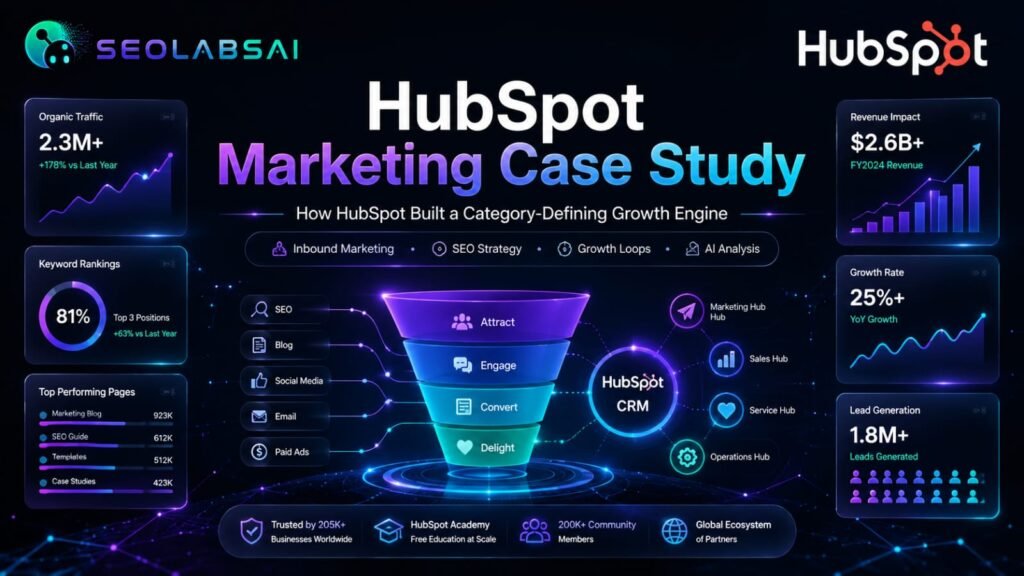
A detailed HubSpot marketing case study explaining how HubSpot scaled using inbound marketing, SEO, content marketing, CRM, AI, lead generation, and growth loops.
Key Takeaways • HubSpot’s core moat isn’t its product feature set — it’s the compounding trust built through free education at scale. • The freemium CRM functions as a distribution mechanism, not just a product tier: it turns software usage itself into a lead-generation and expansion engine. • HubSpot’s SEO strategy (topic clusters, pillar pages) became so influential it’s now taught as a standard practice across the industry. • The business runs on three compounding loops — content, product, and referral — that reinforce each other rather than operating in isolation. • Smaller companies can replicate the underlying mechanics at a fraction of HubSpot’s budget; the framework scales down, even if the execution doesn’t scale up overnight. |
Company Snapshot
| Attribute | Detail |
| Founded | 2006, by Brian Halligan and Dharmesh Shah at MIT |
| Headquarters | Cambridge, Massachusetts |
| Public Listing | NYSE: HUBS (IPO’d October 2014) |
| Mission | Help businesses “grow better” through inbound marketing and customer-centric software |
| Core Products | Marketing Hub, Sales Hub, Service Hub, CMS Hub, Operations Hub, plus a free CRM |
| Business Model | Freemium CRM feeding tiered SaaS subscriptions, with enterprise and AI add-ons |
| Primary Competitors | Salesforce, Zoho, ActiveCampaign, Mailchimp, Pipedrive |
Revenue and headcount figures shift quarterly — pull current numbers from HubSpot’s investor relations page before citing them externally.
The Psychology Behind Why Customers Choose HubSpot
Nobody wakes up wanting a CRM. They wake up worried that leads are falling through the cracks, that their team is guessing instead of measuring, or that a competitor is out-marketing them with half the headcount. HubSpot’s messaging is built around that anxiety — and the growth it promises to unlock — rather than around feature comparisons.
Emotional drivers: growth ambition, fear of losing leads to poor follow-up, the appeal of automation replacing manual busywork, and a desire for one connected system instead of five disconnected tools.
Trust signals doing the heavy lifting: HubSpot Academy’s free certifications, the always-free CRM tier, a library of benchmarked reports, and customer case studies that read like proof rather than promotion.
This is the detail most competitors miss: HubSpot rarely leads with the product. It leads with the problem, lets the prospect self-diagnose using free tools and content, and only introduces the paid product once trust has already been established. By the time someone requests a demo, HubSpot has often already “sold” them through twelve touchpoints of free value.
Inside HubSpot’s Marketing Strategy
HubSpot doesn’t rely on a single growth channel — it layers several, each reinforcing the others.
SEO and Content
This is HubSpot’s foundation. Topic clusters organize content around pillar pages (broad, authoritative overviews) supported by dozens of narrower cluster articles, all interlinked. That structure signals topical depth to search engines and keeps evergreen content ranking for years with periodic refreshes rather than constant rewrites.
Paid Acquisition
Google Ads target high-intent commercial keywords — terms with clear buying signals — paired with dedicated landing pages rather than generic homepage traffic. Meta Ads handle retargeting and promote webinars and lead magnets to warm audiences who’ve already shown interest.
Email and Lifecycle Marketing
Nurture sequences are educational before they’re promotional. A new subscriber gets templates, guides, and benchmarks first; the sales pitch arrives only after several rounds of value delivery.
Community, Partnerships, and Referral
HubSpot Academy and user groups turn customers into practitioners who advocate on the company’s behalf. A large partner ecosystem of agencies extends the sales motion — agencies get certified, then recommend HubSpot to their own client base, effectively multiplying the sales team without adding headcount.
AI Integration
More recently, AI-assisted content tools, predictive CRM insights, and workflow automation have been layered into the existing funnel — speeding up the content and lead-scoring engine rather than replacing the underlying inbound philosophy.
The HubSpot Growth Funnel
Stripped down, the funnel looks deceptively simple. The sophistication is in how tightly each stage is engineered to hand off to the next one.
| Stage | What Happens |
| 1. Organic Traffic | Search-driven visitors arrive via topic-cluster content |
| 2. Educational Blog | Visitor solves an immediate problem, builds trust in the brand |
| 3. Free Template / Tool | A gated resource captures an email in exchange for tangible value |
| 4. Newsletter | Ongoing educational touchpoints keep the lead warm without a sales push |
| 5. Free CRM | Prospect starts using the product itself — the moment of habit formation |
| 6. Paid Hub | Usage hits a natural ceiling; upgrading solves a problem the user already feels |
| 7. Upsell / Enterprise | Expansion revenue as the account and team grow |
| 8. Referral | Satisfied customers and partner agencies feed new prospects back into Stage 1 |
Pro tip: notice that the free CRM sits in the middle of the funnel, not at the end. Most companies treat their product as the finish line; HubSpot treats it as a lead-nurturing channel in its own right — usage data lets the team see exactly when a free account is ready for a sales conversation.
The Growth Loops That Compound Over Time
Funnels describe a single pass. Loops describe what happens when the output of one cycle becomes the input of the next — which is where HubSpot’s real advantage sits.
- Content Loop: content earns rankings, rankings earn traffic, traffic converts to customers, customers become case studies, and case studies become the next round of higher-authority content.
- Product Loop: the free CRM drives usage, usage drives team-wide adoption inside an account, and multi-seat adoption drives upgrades.
- Referral Loop: a customer becomes a certified agency partner, that agency brings its own clients onto HubSpot, and those clients eventually refer others.
Each loop is slow individually. Layered together, they compound — which is the real explanation for why HubSpot’s organic footprint kept expanding years after competitors matched its feature set.
Competitive Advantages: What HubSpot Actually Owns
- Brand trust built over nearly two decades of free education
- HubSpot Academy — a certification ecosystem competitors have struggled to replicate
- One of the largest content libraries in B2B software
- Search visibility across thousands of commercial and informational keywords
- A freemium model that lowers acquisition cost by letting the product sell itself
- An active user and partner community that extends sales and support capacity
- A connected product ecosystem (Marketing, Sales, Service, CMS, Operations Hubs)
- Increasing AI integration across content, CRM insights, and workflow automation
The Inbound Marketing Movement: HubSpot’s Defining Campaign
HubSpot’s single biggest marketing achievement wasn’t a campaign in the traditional sense — it was a category. By naming and evangelizing “inbound marketing,” the company positioned itself as the philosophical alternative to interruptive advertising, then built the software, certification program, and annual conference (INBOUND) to institutionalize that philosophy. Competitors were left in the position of either adopting HubSpot’s vocabulary or arguing against an idea the market had already embraced. That’s a far stronger position than winning a feature comparison.
Where HubSpot Has Stumbled
No growth story is friction-free, and HubSpot’s is no exception.
- Late enterprise push: years of SMB-first positioning made it harder to win larger accounts once the company decided to move upmarket.
- Pricing complexity: multiple Hubs, tiers, and seat-based add-ons have drawn criticism for being difficult to forecast as accounts scale.
- Intensifying AI-native competition: newer entrants built around AI-first workflows are challenging HubSpot’s traditional CRM-plus-content model.
- Feature bloat: a broad product suite risks diluting the simplicity that originally made the free CRM so easy to adopt.
SEO and GEO Analysis: Why HubSpot Ranks Everywhere — Including in AI Answers
HubSpot’s SEO strength comes from structural discipline, not keyword tricks: consistent topic clustering, deep internal linking between pillar and cluster pages, a backlink profile built over years of genuinely useful tools, strong E-E-A-T signals from named authors and cited data, and a content refresh cadence that keeps older pages from decaying in the rankings.
That same structure is what makes HubSpot’s content easy for AI systems to reference. Clear headings, defined terms, FAQ sections, and original research give generative engines like AI Overviews, ChatGPT, and Perplexity clean, well-labeled information to extract and cite — which is precisely the structure this article has been rebuilt around.
Brand Positioning Breakdown
| Element | Detail |
| Voice | Helpful, educational, professional — rarely aggressive or hard-sell |
| Color Palette | Orange and white — energetic but approachable, distinct from the blues that dominate enterprise software |
| Core Positioning Line | “We help businesses grow better.” |
SWOT Analysis
| Category | Details |
| Strengths | Brand trust, HubSpot Academy, SEO dominance, connected product ecosystem |
| Weaknesses | Pricing complexity at scale, product/feature sprawl |
| Opportunities | AI-native features, international expansion, vertical-specific CRMs |
| Threats | Salesforce’s enterprise gravity, AI-native challengers, commoditizing CRM features |
Porter’s Five Forces
| Force | Assessment |
| Threat of New Entrants | Medium — AI has lowered the cost of building competing tools |
| Supplier Power | Low — HubSpot isn’t dependent on scarce suppliers |
| Buyer Power | Medium — many alternatives exist, but switching costs rise with usage |
| Threat of Substitutes | High — point solutions and spreadsheets remain viable for small teams |
| Competitive Rivalry | Very High — crowded CRM and marketing-software category |
Top Growth Opportunities Through 2030
- AI marketing agents that execute campaigns, not just assist with them
- Optimization for AI search surfaces (AI Overviews, ChatGPT, Perplexity) alongside traditional SEO
- Interactive tools and calculators that generate leads while demonstrating product value
- Predictive analytics built into the CRM’s core workflows
- Continued international expansion into underpenetrated markets
- Deeper ties to the creator economy and independent marketing educators
- Vertical-specific CRM configurations for industries with unique workflows
- Voice AI and conversational interfaces for CRM data entry and retrieval
- AI-driven sales coaching layered into Sales Hub
- Personalized learning paths inside HubSpot Academy
10 Marketing Lessons Every Business Can Steal
- Teach before you sell — education earns trust that ads can’t buy.
- Own search intent by mapping content to what buyers are actually asking.
- Build free tools that solve a real problem, not just capture an email.
- Create content that compounds — evergreen topics beat one-off campaigns.
- Treat trust as the primary asset, not a byproduct of good marketing.
- Use email to educate first and pitch second.
- Build community around your product, not just around your brand.
- Invest in SEO as infrastructure, not as a campaign with an end date.
- Turn satisfied customers into active advocates and partners.
- Refresh existing content on a schedule instead of only publishing new content.
The SEOlabsAI Authority Flywheel Framework™
HubSpot’s model can be distilled into a repeatable flywheel — a sequence where each stage funds the next, and momentum builds rather than resets with every new campaign.
Authority Flywheel™ Sequence • Research → uncover a gap competitors haven’t addressed • Original Content → publish the definitive resource on that gap • SEO Rankings → structure and links earn organic visibility • Traffic → rankings convert into consistent visitor volume • Free Tool → a practical resource captures intent, not just attention • Email Subscribers → the relationship continues after the first visit • Community → subscribers become participants, not just readers • Customers → trust converts into paid relationships • Case Studies → customer results become proof for the next research cycle • More Authority → the flywheel accelerates on its own evidence |
How Small Businesses Can Replicate This at Any Budget
| Budget Tier | What to Build |
| $500 / month | One well-researched SEO article per week, one free tool or template, and a basic newsletter to retain readers |
| $5,000 / month | Pillar-and-cluster content architecture, targeted Google Ads on high-intent keywords, and light AI-assisted content production |
| $50,000+ / month | A dedicated content and SEO team, original research or proprietary data reports, regular webinars, and marketing automation across the full funnel |
The mechanics scale down even when the budget doesn’t. A one-person marketing team can’t out-publish HubSpot, but it can absolutely apply the same sequence — teach first, capture the relationship, nurture before pitching — inside a single niche.
Frequently Asked Questions
What made HubSpot’s marketing strategy so effective?
HubSpot built trust before asking for a sale, using free education, tools, and a freemium CRM to attract buyers organically instead of interrupting them with ads.
What is HubSpot’s growth funnel?
It moves prospects from organic content, to a free tool or template, to an email newsletter, to the free CRM, and finally to a paid subscription — with referrals feeding new prospects back into the top of the funnel.
Can small businesses realistically use HubSpot’s inbound model?
Yes. The underlying sequence — educate, capture the relationship, nurture, then sell — works at any budget; only the scale of execution changes.
What is HubSpot’s biggest competitive risk?
AI-native competitors and CRM commoditization, both of which pressure HubSpot to keep proving its ecosystem is worth a premium over simpler point solutions.
Conclusion: The Real Product Was Trust
Strip away the Hubs, the pricing tiers, and the product roadmap, and HubSpot’s growth story comes down to one decision made in 2006: teach the market instead of interrupting it. Every subsequent tactic — the topic clusters, the free CRM, the Academy, the partner ecosystem — is a different expression of that same idea. For any business trying to build durable growth, that’s the transferable lesson: build the educational content, the free tools, and the community first, and let the authority you earn do the selling.