
Traditional advertising has always asked one question: how much can we spend to get attention?
Guerrilla marketing asks a ruder one: what if we get attention before anyone realizes we’re advertising at all?
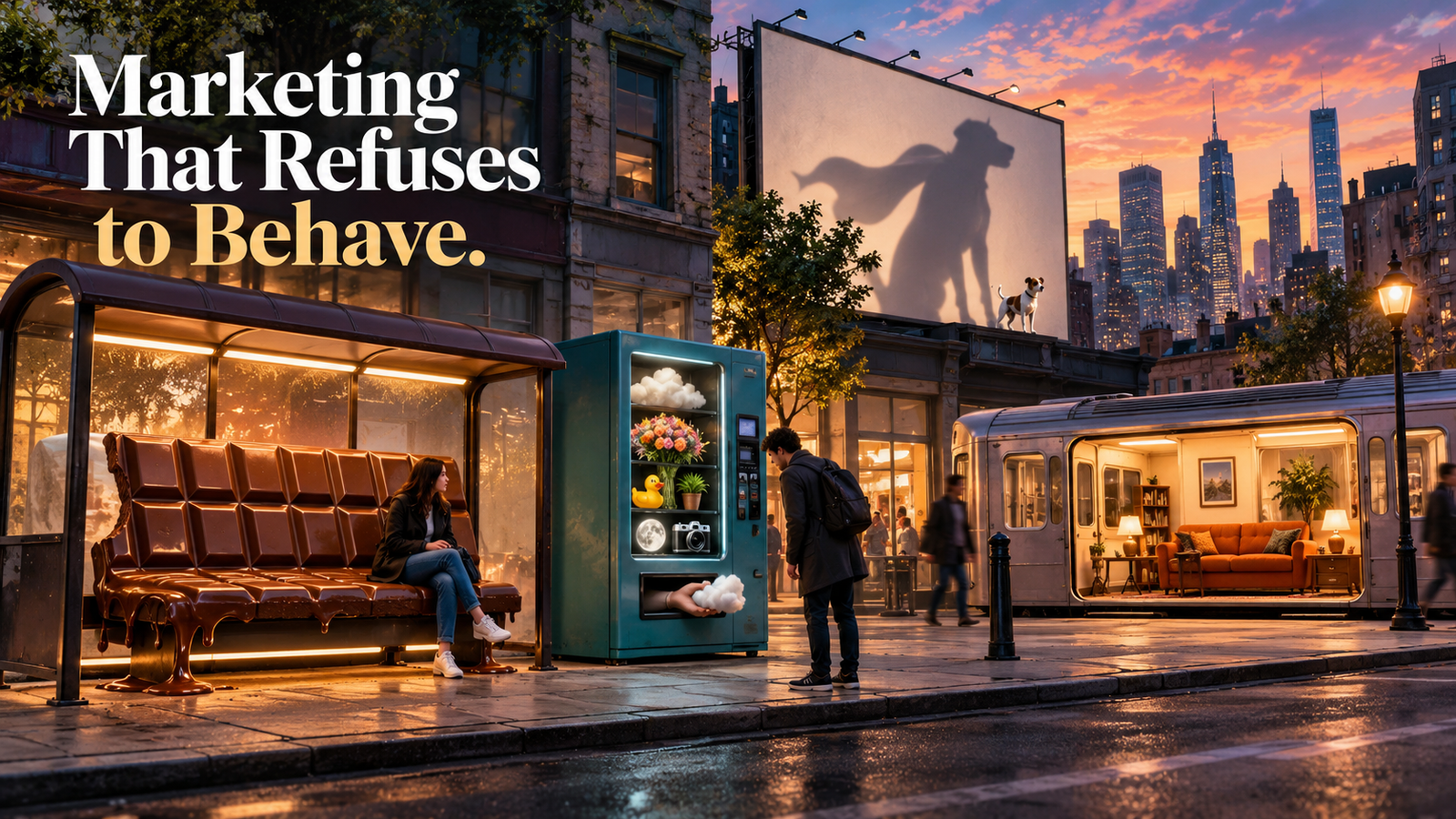
That’s the whole trick. No 30-second slot, no full-page spread, no media plan that costs more than the idea itself. Just a button on a wall, a vending machine that shouldn’t exist, a bench shaped like a chocolate bar. The brand doesn’t interrupt your day. It becomes the weird thing that happened during your day — the thing you can’t help texting a friend about.
The term comes from Jay Conrad Levinson’s 1984 book Guerrilla Marketing, built on the idea that small, unconventional tactics can outperform big spend if the idea itself is strong enough to do the talking. Nearly forty years later, brands with nine-figure ad budgets are still using the same logic, because it turns out humans have never stopped rewarding curiosity, surprise, and a good story to tell at dinner.
Here are 15 times marketers looked at the media plan, put it down, and decided the street — or the subway, or the cinema, or literally the stratosphere — was their billboard instead.
Table of Contents
- The Blair Witch Project — Missing Person Flyers
- Coca-Cola — The Happiness Machine
- Volkswagen — The Piano Staircase
- UNICEF — The Dirty Water Vending Machine
- TNT — Push to Add Drama
- Carlsberg — Bikers in the Cinema
- Red Bull — Stratos Space Jump
- IKEA — The Big Sleepover
- BBC — The Dracula Shadow Billboard
- Burger King — Whopper Detour
- Spotify — “Thanks 2016. It’s Been Weird.”
- Metro Trains Melbourne — Dumb Ways to Die
- KitKat — The Breaker Benches
- Domino’s — Paving for Pizza
- What Ties Them Together
What Is Guerrilla Marketing?
Guerrilla marketing is a low-budget, unconventional promotional strategy that relies on surprise, creativity, and real-world placement instead of paid media reach. Rather than buying attention through ads, brands create an object, stunt, or experience so unexpected that people talk about it, film it, and share it for free — turning the audience itself into the distribution channel.
1. The Blair Witch Project — Missing Person Flyers
- IMAGE PLACEMENT: Top of section 1
- IMAGE TYPE: Actual campaign imagery
- WHAT TO SHOW: A period-accurate “missing person” flyer for one of the film’s three student characters, as distributed at Sundance and on college campuses
- IMAGE SEARCH QUERY: “Blair Witch Project missing person flyer 1999”
- SUGGESTED ALT TEXT: “1999 missing person flyer used in The Blair Witch Project marketing campaign”
- CAPTION: No trailer. No press tour. Just a flyer that made people believe three film students had actually vanished.
- SOURCE/REFERENCE: University of Pittsburgh Library System Horror Studies Collection; The Drum
The Setup
In 1999, three unknown filmmakers had a $60,000 horror movie and zero star power. A traditional campaign — posters, trailers, talk-show appearances — would have been both unaffordable and unconvincing. So the team, led by co-director Eduardo Sánchez, decided not to sell the movie as a movie at all.
The Guerrilla Move
The filmmakers built a website presenting the “Blair Witch” as real regional folklore, complete with fake historical documents and news interviews. Just before release, the Sci-Fi Channel aired a mockumentary treating the legend as fact. And at screenings, film festivals, and college campuses, the team physically handed out and posted missing-person flyers for the three lead actors — who were listed as deceased on IMDb and barred by contract from doing press. Some of those flyers were even put up in Cannes during the film festival.
Why It Worked
This is pattern interruption at the level of belief itself. Instead of asking audiences to suspend disbelief, the campaign removed the option to disbelieve. Curiosity did the rest — the site reportedly drew traffic in the millions at a time when most film sites got a few thousand hits, and word of mouth carried a $60,000 film to a box office haul in the hundreds of millions.
The Marketing Lesson
If your audience has to investigate your story instead of simply consuming it, they’ll do your distribution for you.
The “Okay, That Was Clever” Moment
They didn’t just make a scary movie. They made the marketing scarier than the movie, then let people find that out themselves.
💀 THE BRUTALLY HONEST TAKE: This works brilliantly right up until reality and marketing collide badly — the leaflets in Cannes were pulled a day after a real kidnapping in an unrelated incident made the stunt look tasteless. Even genius ideas need a reality check.
Campaign Snapshot
Field | Detail |
Brand | Haxan Films / Artisan Entertainment |
Year | 1999 |
Location | US college campuses, Sundance, Cannes |
Campaign type | Fabricated-mythology guerrilla + early viral web |
Primary objective | Build pre-release buzz with near-zero marketing budget |
Guerrilla tactic | Missing-person flyers, faked mockumentary, fictional website |
Key takeaway | A story worth investigating spreads faster than a story worth watching |
2. Coca-Cola — The Happiness Machine
- IMAGE PLACEMENT: Top of section 2
- IMAGE TYPE: Actual campaign imagery
- WHAT TO SHOW: Students at St. John’s University reacting to the rigged vending machine dispensing pizza, flowers, and a giant sub sandwich
- IMAGE SEARCH QUERY: “Coca-Cola Happiness Machine St John’s University 2010”
- SUGGESTED ALT TEXT: “Coca-Cola Happiness Machine vending machine surprising students with gifts, 2010”
- CAPTION: A soda machine that gave out pizza, flowers, and a twelve-foot sandwich — and reminded people what “surprise” actually feels like.
- SOURCE/REFERENCE: The Coca-Cola Company investor press release, May 2010; Definition 6
The Setup
Coca-Cola’s “Open Happiness” platform needed a way to connect with teens and college students outside of a typical 30-second spot — something that felt like an experience, not an ad.
The Guerrilla Move
Working with agency Definition 6, Coca-Cola secretly installed a modified vending machine in the student cafeteria at St. John’s University in Queens, New York, along with five hidden cameras. Over two days, the machine dispensed far more than a can of Coke — flowers, pizzas, sunglasses, balloon animals, and a twelve-foot “hero” sandwich, all captured on unscripted hidden-camera footage.
Why It Worked
The product itself never changed. The experience of getting it did. A vending machine represents one of the coldest transactions in modern life — money in, product out — so subverting that expectation with generosity landed as pure delight, and delight is inherently shareable.
The Marketing Lesson
You don’t have to reinvent your product to reinvent how people feel when they receive it.
The “Okay, That Was Clever” Moment
Coca-Cola spent decades telling people it makes them happy. This was the first time it just proved it, on camera, in real time.
💡 THE PSYCHOLOGY: Reciprocity and surprise together are a psychological one-two punch — people don’t just enjoy unexpected generosity, they feel compelled to tell someone about it within minutes.
Campaign Snapshot
Field | Detail |
Brand | Coca-Cola |
Year | 2010 |
Location | St. John’s University, Queens, NY |
Campaign type | Hidden-camera experiential stunt |
Primary objective | Emotionally connect “Open Happiness” tagline to lived experience |
Guerrilla tactic | Rigged vending machine + hidden cameras |
Key takeaway | Surprise generosity beats any tagline at proving a brand promise |
3. Volkswagen — The Piano Staircase
- IMAGE PLACEMENT: Top of section 3
- IMAGE TYPE: Actual campaign imagery
- WHAT TO SHOW: Commuters at Odenplan subway station, Stockholm, stepping on the illuminated black-and-white piano-key staircase
- IMAGE SEARCH QUERY: “Volkswagen Fun Theory piano stairs Odenplan Stockholm”
- SUGGESTED ALT TEXT: “Piano-key staircase installation at Odenplan subway station, part of Volkswagen’s Fun Theory campaign”
- CAPTION: Same stairs. Same escalator next to them. One simple change made 66% more people choose the healthy option.
- SOURCE/REFERENCE: Bloomberg, “A Stairway to Marketing Heaven,” October 2009
The Setup
Volkswagen Sweden wanted to introduce its more fuel-efficient BlueMotion technology, but rather than talk about eco-driving, agency DDB Stockholm built “The Fun Theory” — a public bet that fun changes behavior better than guilt does.
The Guerrilla Move
Overnight, DDB rigged the stairs at Stockholm’s Odenplan subway station, right beside a working escalator, so each step produced a different piano note when stepped on. No signage explained it beforehand. Commuters simply discovered a working, walkable piano keyboard on their way to the platform.
Why It Worked
The experiment measured behavior, not opinions — and the before/after data was the campaign’s real hook. Stair traffic rose 66% compared to the escalator once the piano stairs were installed, according to DDB’s own count, giving journalists and the public a concrete, quotable statistic to spread alongside the video.
The Marketing Lesson
A campaign backed by a real, observable behavior change is far more persuasive than one backed by an opinion or a slogan.
The “Okay, That Was Clever” Moment
Volkswagen wanted to talk about efficient engineering. Instead, it built a musical instrument out of a staircase and let physics do the convincing.
🧠 MARKETER’S TAKE: This is proof-of-concept marketing — instead of claiming your product changes behavior, you stage a tiny, believable demonstration that it does, then let the video do the explaining.
Campaign Snapshot
Field | Detail |
Brand | Volkswagen (with DDB Stockholm) |
Year | 2009 |
Location | Odenplan subway station, Stockholm |
Campaign type | Public behavioral experiment / installation |
Primary objective | Support Volkswagen’s “fun, efficient” brand positioning |
Guerrilla tactic | Interactive piano staircase next to an escalator |
Key takeaway | Show the behavior change, don’t just claim it |
4. UNICEF — The Dirty Water Vending Machine
- IMAGE PLACEMENT: Top of section 4
- IMAGE TYPE: Actual campaign imagery
- WHAT TO SHOW: The repurposed vending machine in Manhattan, its buttons labeled with waterborne disease names like “Cholera” and “Typhoid”
- IMAGE SEARCH QUERY: “UNICEF dirty water vending machine New York 2009”
- SUGGESTED ALT TEXT: “UNICEF vending machine in New York selling bottles of contaminated-looking water labeled with diseases”
- CAPTION: For a dollar, you could buy a bottle of “cholera” or “typhoid.” Nobody drank it. Everyone donated.
- SOURCE/REFERENCE: The One Club creative archive; UNICEF Tap Project
The Setup
UNICEF’s Tap Project needed to make the global water crisis feel real to people in one of the world’s wealthiest cities — and had essentially no production budget to do it.
The Guerrilla Move
Working with agency Casanova Pendrill (now part of McCann), UNICEF converted a broken-down vending machine into a “Dirty Water” dispenser near Union Square, offering eight murky, particle-flecked “flavors” — malaria, cholera, typhoid, dysentery, dengue, hepatitis, salmonella, yellow fever — for one dollar via cash, text donation, or online payment.
Why It Worked
The machine translated a distant statistic into a visceral, physical object New Yorkers could stand in front of and refuse to drink. That refusal was the point: the discomfort of almost buying contaminated water is what made a $1 donation feel meaningful rather than abstract.
The Marketing Lesson
Cause marketing works best when it makes an invisible problem physically unavoidable, even for a few seconds.
The “Okay, That Was Clever” Moment
UNICEF is one of the few organizations that could sell literal filth and call it a win — because the “product” wasn’t the water. It was the moment of hesitation before you said no.
⚡ STEAL THIS IDEA — NOT THE CAMPAIGN: You don’t need a global water crisis to use this mechanic. Any brand can make an abstract problem tangible with one physical object placed where people already are.
Campaign Snapshot
Field | Detail |
Brand | UNICEF |
Year | 2009 |
Location | Manhattan, New York (Union Square area) |
Campaign type | Cause-marketing street activation |
Primary objective | Drive awareness and donations for the global water crisis |
Guerrilla tactic | Repurposed vending machine dispensing “diseased” water for $1 |
Key takeaway | Make the invisible problem physically unavoidable |
5. TNT — Push to Add Drama
- IMAGE PLACEMENT: Top of section 5
- IMAGE TYPE: Actual campaign imagery
- WHAT TO SHOW: The oversized red push button installed in a public square in Flanders, Belgium, with the “Push to add drama” signage
- IMAGE SEARCH QUERY: “TNT push to add drama red button Belgium”
- SUGGESTED ALT TEXT: “Large red push button installation from TNT’s ‘Push to Add Drama’ launch campaign in Belgium”
- CAPTION: One button. One sign. One town square turned into a live-action trailer for a TV channel nobody had heard of yet.
- SOURCE/REFERENCE: Duval Guillaume; Wikipedia, “TNT Benelux”
The Setup
TNT was launching as a new premium drama channel in Belgium with the tagline “We know drama” — and no existing audience relationship to lean on.
The Guerrilla Move
Agency Duval Guillaume installed a giant red push button in an ordinary town square with a sign reading “Push to add drama,” then waited. Anyone who dared press it was suddenly caught in a rapid-fire sequence of staged chaos — fights, chases, and dramatic set pieces referencing TNT’s programming — all filmed by hidden cameras for their unscripted reactions.
Why It Worked
Curiosity is one of the strongest triggers in human psychology, and a big red button practically begs to be pushed. TNT didn’t have to explain its “drama” positioning in a script — it let the audience cause the drama themselves, which made the brand promise something people experienced rather than something they were told.
The Marketing Lesson
If your brand promise can be turned into a single physical action, let people trigger it themselves instead of narrating it at them.
The “Okay, That Was Clever” Moment
Most channels buy airtime to tell you they’re dramatic. TNT built a button that made ordinary people the stars of their own tiny disaster movie — for free.
🔥 WHY IT BLEW UP: The official video reportedly passed 10 million views within 48 hours of release and kept climbing, according to contemporary trade coverage — a launch campaign for a new channel outperforming most of the shows it was advertising.
Campaign Snapshot
Field | Detail |
Brand | TNT (with Duval Guillaume) |
Year | 2012 |
Location | Flanders, Belgium |
Campaign type | Ambient / hidden-camera activation |
Primary objective | Launch awareness for new TV channel |
Guerrilla tactic | Public push-button trigger for staged drama |
Key takeaway | Let the audience trigger the brand experience themselves |
6. Carlsberg — Bikers in the Cinema
- IMAGE PLACEMENT: Top of section 6
- IMAGE TYPE: Actual campaign imagery
- WHAT TO SHOW: A wide shot of the packed Kinepolis cinema auditorium in Brussels, filled with 148 bikers, with two empty seats visible in the center
- IMAGE SEARCH QUERY: “Carlsberg bikers cinema stunt Brussels 2011”
- SUGGESTED ALT TEXT: “148 bikers seated in a Brussels cinema during Carlsberg’s hidden-camera ‘That Calls for a Carlsberg’ stunt”
- CAPTION: Two empty seats. 148 bikers. One brand betting that your assumptions are the real punchline.
- SOURCE/REFERENCE: Campaign UK, September 2011; Ads of the World
The Setup
Carlsberg had just launched a new global strapline, “That calls for a Carlsberg,” built around the idea of earning genuine approval rather than manufacturing hype.
The Guerrilla Move
Duval Guillaume Modem staged a hidden-camera stunt at Kinepolis cinema in Brussels: 148 leather-clad bikers filled an auditorium, leaving exactly two seats empty, dead center. Unsuspecting couples who’d bought ordinary movie tickets walked in to find their only available seats surrounded by an intimidating crowd — and had to decide, on camera, whether to sit down or walk out.
Why It Worked
The stunt weaponized a stereotype the audience already held, then flipped it — the couples who stayed were met with cheers and a round of Carlsberg, not trouble. That reversal did the brand’s positioning work without a single line of dialogue about the beer itself.
The Marketing Lesson
If your brand promise is “you’ll be pleasantly surprised,” build a situation designed to trigger the audience’s worst assumption first.
The “Okay, That Was Clever” Moment
Carlsberg essentially cast 148 extras as a jump scare, then made the twist ending be kindness. That’s a braver script than most ad agencies would greenlight.
🔥 WHY IT BLEW UP: The stunt attracted more than a million YouTube views within days of posting, per Campaign’s contemporary reporting — a huge return for a single-location shoot with no traditional media buy behind it.
Campaign Snapshot
Field | Detail |
Brand | Carlsberg (with Duval Guillaume Modem) |
Year | 2011 |
Location | Kinepolis Cinema, Brussels, Belgium |
Campaign type | Hidden-camera social experiment |
Primary objective | Launch new “That calls for a Carlsberg” global strapline |
Guerrilla tactic | Staged biker-filled cinema with hidden reactions |
Key takeaway | Set up the stereotype, then let the reveal do the branding |
7. Red Bull — Stratos Space Jump
- IMAGE PLACEMENT: Top of section 7
- IMAGE TYPE: Actual campaign / editorial imagery
- WHAT TO SHOW: Felix Baumgartner stepping off the Stratos capsule platform at 128,000 feet above Roswell, New Mexico
- IMAGE SEARCH QUERY: “Red Bull Stratos Felix Baumgartner jump 2012”
- SUGGESTED ALT TEXT: “Felix Baumgartner stepping off the Red Bull Stratos capsule during his 2012 stratospheric jump”
- CAPTION: Eight million people watched live as one man fell faster than the speed of sound — and the drink barely got mentioned.
- SOURCE/REFERENCE: Guinness World Records; FAI (World Air Sports Federation)
The Setup
“Red Bull gives you wings” had been a slogan for over two decades. Red Bull decided to make it literal — and prove its brand isn’t about a drink, it’s about human limits.
The Guerrilla Move
Red Bull spent roughly five years and a reported $20 million developing Stratos: a mission to send Austrian skydiver Felix Baumgartner to the edge of the stratosphere in a pressurized capsule, then have him jump. On October 14, 2012, Baumgartner ascended to 38,969.4 meters and free-fell for over four minutes, breaking the sound barrier and multiple world records along the way.
Why It Worked
This wasn’t advertising about extremity — it was extremity, live-streamed. Roughly 8 million concurrent viewers watched on YouTube at the jump’s peak, according to Red Bull and contemporaneous reporting, making it the largest live stream the platform had hosted to that point. Red Bull’s logo appeared everywhere in the footage, yet the story people told each other was about Baumgartner, not the can.
The Marketing Lesson
The most powerful brand association isn’t your logo on the screen — it’s being the reason an extraordinary moment was possible at all.
The “Okay, That Was Clever” Moment
Most brands sponsor an athlete. Red Bull sponsored gravity, and let a man in a spacesuit be the ad.
⚡ STEAL THIS IDEA — NOT THE CAMPAIGN: You almost certainly don’t have $20 million or a stratospheric balloon budget — but the underlying move (fund something genuinely remarkable your audience already cares about, and let it carry your name) scales down to local sponsorships and community events too.
Campaign Snapshot
Field | Detail |
Brand | Red Bull |
Year | 2012 |
Location | Roswell, New Mexico, USA |
Campaign type | Branded real-world spectacle / live stream event |
Primary objective | Reinforce “gives you wings” brand platform through lived proof |
Guerrilla tactic | Sponsored record-breaking human feat, live-streamed globally |
Key takeaway | Fund the extraordinary moment; let it carry the brand |
8. IKEA — The Big Sleepover
- IMAGE PLACEMENT: Top of section 8
- IMAGE TYPE: Actual campaign imagery
- WHAT TO SHOW: Guests in pajamas settling into showroom beds inside an IKEA Essex store at night, staff in comedian/host roles nearby
- IMAGE SEARCH QUERY: “IKEA Big Sleepover Essex store 2011”
- SUGGESTED ALT TEXT: “Guests sleeping over in an IKEA Essex showroom during the brand’s Big Sleepover event”
- CAPTION: A Facebook joke about spending the night at IKEA. IKEA said, “Sure — pajamas required.”
- SOURCE/REFERENCE: Contemporary UK retail and marketing press coverage of the 2011 event
The Setup
A viral Facebook group titled “I wanna have a sleepover in IKEA” had racked up thousands of members joking about literally living in the store’s showroom beds.
The Guerrilla Move
IKEA didn’t ignore the joke — it made it real. The brand invited 100 fans to an overnight event at its Essex, UK store, complete with sleep consultations, massages, snacks, and a comedian tucking guests into showroom beds.
Why It Worked
IKEA turned a piece of organic, unprompted fan culture into an actual brand experience instead of trying to manufacture its own idea from scratch. That’s a rare kind of guerrilla marketing — one where the “surprise” is that the brand was actually listening.
The Marketing Lesson
Some of your best campaign ideas are already circulating in your comments section. Guerrilla marketing doesn’t always mean inventing a stunt — sometimes it means having the nerve to say yes to one your audience invented for you.
The “Okay, That Was Clever” Moment
IKEA’s actual product is “you’ll want to live in our showroom.” This time, they just let 100 people literally do it.
🧠 MARKETER’S TAKE: Social listening isn’t just for complaint-monitoring. The internet occasionally hands brands a fully-formed campaign concept for free — the job is recognizing it and being brave enough to greenlight it.
Campaign Snapshot
Field | Detail |
Brand | IKEA |
Year | 2011 |
Location | Essex, United Kingdom |
Campaign type | Fan-culture-driven experiential event |
Primary objective | Strengthen emotional brand affinity and earn media coverage |
Guerrilla tactic | Turning a viral joke into a real overnight in-store event |
Key takeaway | Listen for the campaign your audience is already writing |
9. BBC — The Dracula Shadow Billboard
- IMAGE PLACEMENT: Top of section 9
- IMAGE TYPE: Actual campaign imagery
- WHAT TO SHOW: A side-by-side of the billboard by day (blood-red stakes on a blank surface) and by night (the stakes’ shadows forming Dracula’s silhouette)
- IMAGE SEARCH QUERY: “BBC Dracula shadow billboard day night”
- SUGGESTED ALT TEXT: “BBC Dracula billboard shown by day with red stakes and by night with a shadow silhouette of Dracula”
- CAPTION: By day, just a cluster of stakes. By night, the Count himself steps out of the shadows.
- SOURCE/REFERENCE: Talon OOH case study; The Drum, “World’s Best OOH Ads Ever”
The Setup
BBC Creative had to launch yet another Dracula adaptation into a market already saturated with vampire content — and needed a way to feel fresh without a single new plot detail to lean on.
The Guerrilla Move
Working with Havas, Talon, and Grand Visual, BBC Creative built a special billboard in London and Birmingham that appeared to be nothing more than a scatter of bloody wooden stakes by day. As night fell, a precisely positioned spotlight cast the stakes’ shadows into an unmistakable silhouette of Dracula’s face — with an “In Case of Vampires, Break Glass” box mounted below it, containing a stake.
Why It Worked
The billboard didn’t tell the vampire myth — it performed it, using the exact detail (vampires only appear at night) that makes the character recognizable in the first place. The transformation itself, captured in a time-lapse video, became the shareable asset.
The Marketing Lesson
If your source material has one iconic, defining trait, build the entire campaign mechanic around dramatizing that trait — not describing it.
The “Okay, That Was Clever” Moment
Most billboards fight to be seen once. This one was designed to be watched twice a day, by the same people, without ever changing a single word.
🔥 WHY IT BLEW UP: The time-lapse transformation video passed 7 million views, and the campaign generated tens of thousands of social posts alongside major press coverage, according to Talon’s published case study.
Campaign Snapshot
Field | Detail |
Brand | BBC One / BBC Creative |
Year | 2019 |
Location | London and Birmingham, UK |
Campaign type | Special-build out-of-home (OOH) installation |
Primary objective | Generate buzz and PR for the Dracula series launch |
Guerrilla tactic | Light-and-shadow billboard that transforms at nightfall |
Key takeaway | Dramatize your subject’s most iconic trait, don’t just state it |
10. Burger King — Whopper Detour
- IMAGE PLACEMENT: Top of section 10
- IMAGE TYPE: Actual campaign / editorial imagery
- WHAT TO SHOW: A smartphone showing the Burger King app’s geofenced “Whopper for 1¢” notification with a McDonald’s location visible nearby
- IMAGE SEARCH QUERY: “Burger King Whopper Detour app 2018”
- SUGGESTED ALT TEXT: “Burger King app notification offering a penny Whopper when users are near a McDonald’s location, 2018 Whopper Detour campaign”
- CAPTION: Get within 600 feet of a McDonald’s. Get a Whopper for a penny. Just not at McDonald’s.
- SOURCE/REFERENCE: Marketing Dive, “Campaign of the Year: Burger King’s ‘Whopper Detour’”
The Setup
Burger King had just redesigned its mobile app with order-ahead functionality, but needed a reason significant enough to make people actually download it.
The Guerrilla Move
From December 4–12, 2018, Burger King used geofencing technology to trigger a push notification the moment a user’s phone came within 600 feet of one of roughly 14,000 U.S. McDonald’s locations, offering a Whopper for one cent — redeemable only through the BK app, and only by navigating away to the nearest Burger King.
Why It Worked
This is guerrilla marketing built entirely out of code instead of concrete — no physical stunt required, just a rival’s real estate turned into the trigger zone for your own promotion. The stunt’s inherent cheekiness (literally routing customers out of a competitor’s parking lot) generated its own press coverage on top of the paid incentive.
The Marketing Lesson
Guerrilla tactics don’t require a physical street anymore — geofencing, app notifications, and location data are now the “unexpected context” that traditional guerrilla marketing always looked for.
The “Okay, That Was Clever” Moment
Burger King effectively rented 14,000 McDonald’s parking lots for nine days, without paying McDonald’s a cent.
🔥 WHY IT BLEW UP: The campaign reportedly drove the BK app to the #1 spot on the U.S. App Store across all categories and generated roughly 1.5 million downloads, according to Burger King’s parent company and contemporaneous marketing trade coverage.
Campaign Snapshot
Field | Detail |
Brand | Burger King |
Year | 2018 |
Location | Nationwide, United States |
Campaign type | Geofenced mobile-app promotion |
Primary objective | Drive Burger King app downloads and reposition against McDonald’s |
Guerrilla tactic | Location-triggered penny-Whopper offer near competitor stores |
Key takeaway | Digital location data is the new “unexpected place” for guerrilla ideas |
11. Spotify — “Thanks 2016. It’s Been Weird.”
- IMAGE PLACEMENT: Top of section 11
- IMAGE TYPE: Actual campaign imagery
- WHAT TO SHOW: One of the real Spotify billboards referencing an oddly specific piece of user listening data (e.g., the Brexit-day streaming stat)
- IMAGE SEARCH QUERY: “Spotify Thanks 2016 billboard campaign”
- SUGGESTED ALT TEXT: “Spotify billboard reading a witty message based on real user listening data, 2016 year-end campaign”
- CAPTION: No creative brief writes a better joke than 3,749 real strangers streaming a REM song on the day of the Brexit vote.
- SOURCE/REFERENCE: B&T Magazine, December 2016
The Setup
At the end of 2016 — a chaotic year by most measures — Spotify’s in-house team wanted to close the year without another generic “Year in Review” post nobody would remember.
The Guerrilla Move
Spotify mined its own anonymized listening data for the strangest, funniest patterns it could find, then turned them into billboard copy with the tagline “Thanks 2016. It’s been weird.” One UK billboard read: “Dear 3,749 people who streamed ‘It’s The End Of The World As We Know It’ the day of the Brexit Vote. Hang in There.” The campaign rolled out across 14 markets including the US, UK, France, and Germany.
Why It Worked
Nothing on the billboard was invented. Every line was a real, if anonymized, behavioral pattern pulled straight from the platform — which made it feel less like advertising copy and more like the internet’s collective inside joke, displayed at billboard scale.
The Marketing Lesson
If your product generates data nobody else has access to, that data is your most original creative asset — more distinctive than any slogan a copywriter could invent from scratch.
The “Okay, That Was Clever” Moment
Most brands are terrified to admit they know this much about you. Spotify turned that same fact into the entire punchline.
💡 THE PSYCHOLOGY: People love being seen — even anonymously, even as a punchline — far more than they love being sold to. This became the direct ancestor of Spotify’s now-massive annual “Wrapped” campaign.
Campaign Snapshot
Field | Detail |
Brand | Spotify |
Year | 2016 |
Location | US, UK, France, Germany, and 10 additional markets |
Campaign type | Data-driven out-of-home (OOH) |
Primary objective | Year-end brand engagement and cultural relevance |
Guerrilla tactic | Real anonymized user-data billboards |
Key takeaway | Your own product data can out-write your ad agency |
12. Metro Trains Melbourne — Dumb Ways to Die
- IMAGE PLACEMENT: Top of section 12
- IMAGE TYPE: Actual campaign imagery
- WHAT TO SHOW: A still frame of the “Dumb Ways to Die” animated characters from the original music video
- IMAGE SEARCH QUERY: “Dumb Ways to Die Metro Trains Melbourne characters”
- SUGGESTED ALT TEXT: “Animated characters from Metro Trains Melbourne’s ‘Dumb Ways to Die’ rail safety campaign”
- CAPTION: A rail safety PSA became a chart-topping song, a mobile game, and one of the most-shared ads in internet history.
- SOURCE/REFERENCE: Wikipedia, “Dumb Ways to Die”; The Drum, December 2012
The Setup
Metro Trains Melbourne needed to reduce accidents and near-misses around its rail network — a message that traditionally gets delivered through grim, forgettable safety posters nobody reads twice.
The Guerrilla Move
Agency McCann Melbourne skipped the “advertising model” entirely and built a “content model” instead: a three-minute animated music video where adorable bean-shaped characters die in absurd, darkly funny ways (setting their hair on fire, poking a bear, selling both kidneys online), building to the real point — three characters dying from preventable train accidents.
Why It Worked
By refusing to look, sound, or feel like a safety ad, the campaign got shared the way entertainment gets shared, not the way warnings get ignored. It became a mobile game, a children’s book, and a genuine radio hit — all still carrying the underlying safety message.
The Marketing Lesson
If your message is one people are conditioned to tune out (safety, insurance, terms and conditions), the winning move is often to stop looking like that category entirely.
The “Okay, That Was Clever” Moment
A government transit safety campaign out-charted actual pop songs on iTunes. Somewhere, a jingle writer is still not over it.
🔥 WHY IT BLEW UP: The video reached the iTunes Top 10 in multiple countries within 24 hours and has since accumulated hundreds of millions of YouTube views, becoming one of the most-shared public safety campaigns ever produced.
Campaign Snapshot
Field | Detail |
Brand | Metro Trains Melbourne (with McCann Melbourne) |
Year | 2012 |
Location | Melbourne, Australia (global reach) |
Campaign type | Viral animated content campaign |
Primary objective | Reduce accidents and dangerous behavior around trains |
Guerrilla tactic | Entertainment-first content that hides the safety message inside a song |
Key takeaway | Escape your category’s expected tone entirely if that tone is being ignored |
13. KitKat — The Breaker Benches
- IMAGE PLACEMENT: Top of section 13
- IMAGE TYPE: Actual campaign imagery
- WHAT TO SHOW: A KitKat-branded bus-shelter bench shaped like an oversized chocolate bar, with commuters seated on it
- IMAGE SEARCH QUERY: “KitKat bench bus stop have a break”
- SUGGESTED ALT TEXT: “KitKat-branded bus stop bench shaped like a chocolate bar, part of the brand’s ‘Have a Break’ street furniture campaign”
- CAPTION: “Have a break, have a KitKat” isn’t just a slogan here — it’s literally the seat you’re sitting on.
- SOURCE/REFERENCE: Campaign Asia; Ads of the World
The Setup
“Have a break, have a KitKat” has been the brand’s tagline for close to 90 years — durable enough to survive, but at risk of becoming wallpaper if the brand only ever said it instead of building it.
The Guerrilla Move
Across multiple markets over the years — Hong Kong, Colombia, Paraguay, Denmark, and the Philippines among them — Nestlé and its agencies have repeatedly turned actual public street furniture into KitKat “break” experiences: bus shelter benches built to look like giant KitKat bars, interactive dancing bus shelters that dispense a real bar as a reward, and even hammocks installed at bus stops to make a boring wait genuinely restful.
Why It Worked
Instead of showing people what a “break” looks like in a 15-second spot, KitKat let commuters — who were already tired and already waiting — physically experience one, for free, at the exact moment the brand promise was most relevant to them.
The Marketing Lesson
The most convincing product demo isn’t staged. It’s placed at the exact moment and location where your audience already needs what you’re selling.
The “Okay, That Was Clever” Moment
Most chocolate brands buy ad space. KitKat just kept quietly redesigning the furniture of everyday boredom.
⚡ STEAL THIS IDEA — NOT THE CAMPAIGN: Ask where your customers are already forced to wait, queue, or pause — that dead time is free real estate for a brand that can make it 30 seconds better.
Campaign Snapshot
Field | Detail |
Brand | KitKat (Nestlé) |
Markets | Hong Kong, Colombia, Paraguay, Philippines, Denmark, and others |
Campaign type | Recurring street-furniture / ambient marketing platform |
Primary objective | Reinforce “Have a Break, Have a KitKat” in a literal, physical way |
Guerrilla tactic | Branded bus-stop benches, hammocks, and interactive shelters |
Key takeaway | Redesign the moment of dead time your audience is already living through |
14. Domino’s — Paving for Pizza
- IMAGE PLACEMENT: Top of section 14
- IMAGE TYPE: Actual campaign imagery
- WHAT TO SHOW: A freshly repaired pothole on a US street with the Domino’s “Oh yes we did” logo stenciled onto the patch
- IMAGE SEARCH QUERY: “Domino’s Paving for Pizza pothole logo”
- SUGGESTED ALT TEXT: “Repaired pothole with Domino’s Paving for Pizza logo stenciled onto the pavement”
- CAPTION: A pizza company started fixing potholes. It worked because the reason was almost too honest to be an ad.
- SOURCE/REFERENCE: Domino’s investor press release, August 2018; Vice, “The Inside Story of How Domino’s Got Its Advertising on Potholes”
The Setup
Domino’s had a genuinely mundane operational problem: potholes were physically damaging carryout pizzas on the drive home, hurting the product experience after the sale was already made.
The Guerrilla Move
Domino’s launched “Paving for Pizza,” offering grants of up to $5,000 to US municipalities to repair potholes and cracked roads, in exchange for stenciling the Domino’s logo and the phrase “Oh yes we did” onto the freshly repaired pavement. The brand let customers nominate their own towns, and the response — more than 137,000 nominations across all 50 states — was so large that Domino’s expanded the program well beyond its original 20-city plan.
Why It Worked
The insight was almost embarrassingly literal, which is exactly what made it credible: nobody thinks “pizza company repairs roads” is a cynical stretch once you hear the actual reasoning. It also generated a rare kind of guerrilla marketing — infrastructure that keeps advertising for the brand every single day, indefinitely, for the cost of one small municipal grant.
The Marketing Lesson
The most believable guerrilla idea is often hiding inside your actual, unglamorous operational problems — not in a brainstorm about “cool stunts.”
The “Okay, That Was Clever” Moment
Domino’s found a way to advertise on public infrastructure without paying for a single billboard permit.
💀 THE BRUTALLY HONEST TAKE: It also drew real criticism — some residents and city officials publicly questioned whether letting a private company brand public roads sets an uncomfortable precedent for who gets to “own” shared civic space next.
Campaign Snapshot
Field | Detail |
Brand | Domino’s Pizza |
Year | 2018 |
Location | Multiple US municipalities, nationwide |
Campaign type | Branded civic infrastructure / cause-adjacent marketing |
Primary objective | Build goodwill and earned media around a real product-quality issue |
Guerrilla tactic | Funding pothole repairs branded with the Domino’s logo |
Key takeaway | Your most convincing guerrilla idea might be a genuine business problem in disguise |
What These 15 Campaigns Have in Common
Campaign | Surprise | Humor | Emotional Hook | Social Sharing | Physical Experience | Earned Media | Risk Level |
Blair Witch Flyers | High | Low | High (fear) | High | Medium | Very High | High |
Coca-Cola Happiness Machine | High | Medium | High (joy) | High | High | High | Low |
VW Piano Staircase | Medium | Medium | Medium | High | High | High | Low |
UNICEF Dirty Water | High | Low | High (guilt/empathy) | Medium | High | High | Medium |
TNT Push to Add Drama | High | High | Medium | High | High | High | Medium |
Carlsberg Bikers | High | High | Medium | High | High | High | Medium |
Red Bull Stratos | High | Low | High (awe) | High | Very High | Very High | Very High |
IKEA Big Sleepover | Medium | Medium | High (delight) | Medium | High | Medium | Low |
BBC Dracula Billboard | Medium | Low | Medium | High | Medium | High | Low |
Burger King Whopper Detour | Medium | High | Low | High | Low (digital) | Very High | Medium |
Spotify “Thanks 2016” | Medium | High | Medium | High | Low | High | Low |
Dumb Ways to Die | Medium | High | Medium | Very High | Low | Very High | Medium |
KitKat Breaker Benches | Low | Low | Medium | Medium | High | Medium | Low |
Domino’s Paving for Pizza | Medium | Low | Medium | Medium | High | High | Medium |
A few patterns jump out immediately. Every single campaign here scores high on either surprise or emotional hook — usually both. Almost none of them required a large media buy to reach their first wave of attention; the idea itself generated the reach. And the campaigns with the highest risk level (Blair Witch, Red Bull Stratos) are also, not coincidentally, the ones still being taught in marketing courses decades later — because genuine risk is what makes a story worth retelling.
How to Create Your Own Guerrilla Marketing Campaign
- Find the attention gap. Where is your audience bored, waiting, or being ignored by every other advertiser?
- Identify an unexpected context. What object, location, or moment does your brand have no business being associated with — until it is?
- Build a simple visual idea. If you can’t sketch it in one frame, it’s too complicated to go viral.
- Create a story people want to tell. Ask: would a stranger repeat this at dinner, or does it need you to explain the brand strategy behind it?
- Make participation easy. The best guerrilla ideas require zero instructions — pushing a button, sitting on a bench, walking past a shadow.
- Design for social sharing. Assume the only camera that matters is the one already in everyone’s pocket.
- Build earned-media potential. Would a local news editor or industry blog want to write about this even without being paid to?
- Measure the impact. Views and shares are vanity unless tied to a real behavior — downloads, donations, foot traffic, sign-ups.
- Have a contingency plan. Know exactly how you’ll respond if the stunt is misread, goes wrong, or attracts unwanted attention — before it launches, not after.
10 Guerrilla Marketing Ideas You Could Actually Steal
- The “Missing Something” Poster. A local bakery posts “missing” flyers around the neighborhood for a fictional pastry that’s “gone missing” from shelves — QR code leads to a limited comeback offer.
- The Waiting-Room Takeover. A dentist or clinic redesigns its waiting-room chairs or magazines around a genuinely useful, branded distraction (a five-minute meditation card deck, not another leaflet).
- The Chalk Confession Wall. A therapy or wellness brand sets up a public chalkboard with a prompt like “What are you carrying today?” near a busy transit stop — photographed responses become organic social content.
- The Reverse Lost-and-Found. A coffee shop “loses” branded tote bags in public spaces (parks, libraries) with a note: “Finders keepers, if you tag us.”
- The Repair Table. A local clothing brand sets up a free pop-up mending station in a park one Saturday — visible craft, zero hard sell.
- The One-Star Menu Item. A restaurant deliberately puts one “so-so” dish on the menu labeled honestly, betting that radical honesty gets screenshotted more than another “chef’s special.”
- The Community Whiteboard. A hardware store installs a public whiteboard outside asking neighbors what they’re building this weekend — restocked with relevant supplies displayed nearby.
- The Silent Storefront. A retail brand blacks out its own storefront windows for one day with a single line: “Come back tomorrow. It’ll make sense.” (Only works if tomorrow genuinely delivers.)
- The Borrowed Bench. A moving or storage company sponsors and rebrands a single, well-placed public bench near a busy relocation corridor with a genuinely useful line, not just a logo.
- The Unlocked Vending Machine. A local business rigs an old vending machine to dispense something unexpected and free for one day — a flower, a book, a coupon — timed to a slow sales period.
None of these copy the 15 campaigns above directly — they borrow the underlying mechanic (unexpected context, physical participation, a story worth repeating) and scale it down to a genuinely small budget.
Guerrilla Marketing vs. Traditional Advertising
Factor | Traditional Advertising | Guerrilla Marketing |
Budget | High, ongoing media spend | Low to moderate, idea-driven |
Attention | Bought through reach and frequency | Earned through surprise and relevance |
Distribution | Paid channels (TV, print, digital ads) | Word of mouth, press, and social sharing |
Risk | Lower — predictable, controlled | Higher — public reception can’t be fully controlled |
Creativity | Constrained by media format | Constrained mainly by the idea itself |
Earned Media | Limited, often requires separate PR push | Frequently the primary distribution mechanism |
Virality | Rare, usually not the core objective | Often the explicit goal |
Measurement | Impressions, reach, frequency | Shares, press mentions, behavior change, sign-ups |
When Guerrilla Marketing Goes Horribly Wrong
Guerrilla marketing isn’t automatically brilliant just because it’s unconventional. Because there is a very thin line between “marketing genius” and “someone should probably call legal.”
Public disruption and panic. In 2007, a guerrilla marketing campaign for a Cartoon Network show placed blinking LED devices around Boston to promote the series; several were mistaken for possible explosives, triggering a citywide bomb scare, evacuations, and the shutdown of transit infrastructure. The network’s parent company ultimately paid a multimillion-dollar settlement to the city.
Misreading the room. The Blair Witch Project’s Cannes flyer drop, discussed above, had to be pulled the day after a real, unrelated kidnapping made the stunt look tone-deaf rather than clever — a reminder that timing and current events can turn a strong idea into a liability overnight.
Public backlash over civic space. Domino’s “Paving for Pizza,” despite its warm reception overall, also drew criticism from residents and local officials uneasy about a private company branding public infrastructure — raising the question of what precedent it sets for future advertisers.
The common thread: the same qualities that make guerrilla marketing powerful — surprise, ambiguity, public participation — are exactly what make it hard to control once it’s live. A campaign that depends on people misreading a situation, even briefly, always carries real risk.
Frequently Asked Questions
What is an example of guerrilla marketing? Coca-Cola’s “Happiness Machine” is a widely cited example — a hidden-camera stunt where a rigged vending machine surprised college students with gifts instead of just a soda.
What are the four types of guerrilla marketing? Marketers commonly group guerrilla tactics into four categories: ambient marketing (branding an everyday object or space), ambush marketing (piggybacking on a competitor’s or event’s attention), stealth/undercover marketing (promotion disguised as organic activity), and viral marketing (content engineered to be shared).
Why is guerrilla marketing effective? It works because it triggers curiosity and surprise rather than interrupting attention, which makes the audience more likely to share the experience voluntarily — turning the campaign’s reach into earned media instead of paid media.
What is the difference between guerrilla marketing and traditional advertising? Traditional advertising buys attention through paid reach and frequency; guerrilla marketing earns attention through unconventional placement, surprise, and word of mouth, usually at a fraction of the cost.
Is guerrilla marketing expensive? It can be extremely cheap (a UNICEF vending machine repurposed for a few hundred dollars) or extremely expensive (Red Bull’s Stratos jump reportedly cost around $20 million) — the defining trait isn’t a small budget, it’s an outsized return relative to spend.
How can small businesses use guerrilla marketing? Small businesses can focus on hyper-local, low-cost tactics: sponsoring or redesigning a piece of everyday street furniture, running a hidden-camera-style stunt in-store, or turning an existing viral moment from their own community into a real event, as IKEA did with its Big Sleepover.
Is guerrilla marketing legal? Most guerrilla marketing is legal, but it operates close to regulatory and property lines — campaigns involving public space, unauthorized placements, or ambush marketing at ticketed events can carry legal risk and should be reviewed with local permitting and legal counsel before launch.
Does guerrilla marketing work for B2B brands? Yes, though the mechanics shift — B2B guerrilla tactics tend to lean on data-driven surprise (like Spotify’s data billboards) or high-craft installations at industry events rather than mass-market street stunts.
How do you measure guerrilla marketing success? Beyond views and shares, strong campaigns tie back to a measurable action: app downloads (Burger King), donations (UNICEF), or a documented behavior change (Volkswagen’s 66% stair-usage increase).
What’s the biggest risk of guerrilla marketing? Losing control of the narrative — because guerrilla tactics rely on public reaction and interpretation, a campaign can be misread, go viral for the wrong reasons, or collide badly with real-world events, as several examples above show.
Conclusion
None of the campaigns in this list won because a brand outspent its competitors. They won because someone noticed an ordinary object — a staircase, a bench, a vending machine, a billboard — and asked what would happen if it stopped behaving like an ordinary object for one day.
That’s the real takeaway for any marketer working with a modest budget in 2026: the biggest advertisement in the world doesn’t have to interrupt anyone’s day. Sometimes it just needs to become part of it.
Looking to study more campaigns like these, or benchmark your own brand’s creative against what’s actually earning attention right now? [INTERNAL LINK OPPORTUNITY — Anchor: “AI-powered competitor and campaign analysis,” Destination: SEOLabsAI tool/article on marketing intelligence and competitor research, Placement: this paragraph] can help you track what’s working across your industry before you commit budget to your next big idea.